SUBMIT YOUR WORK
*
SUBMIT YOUR WORK *
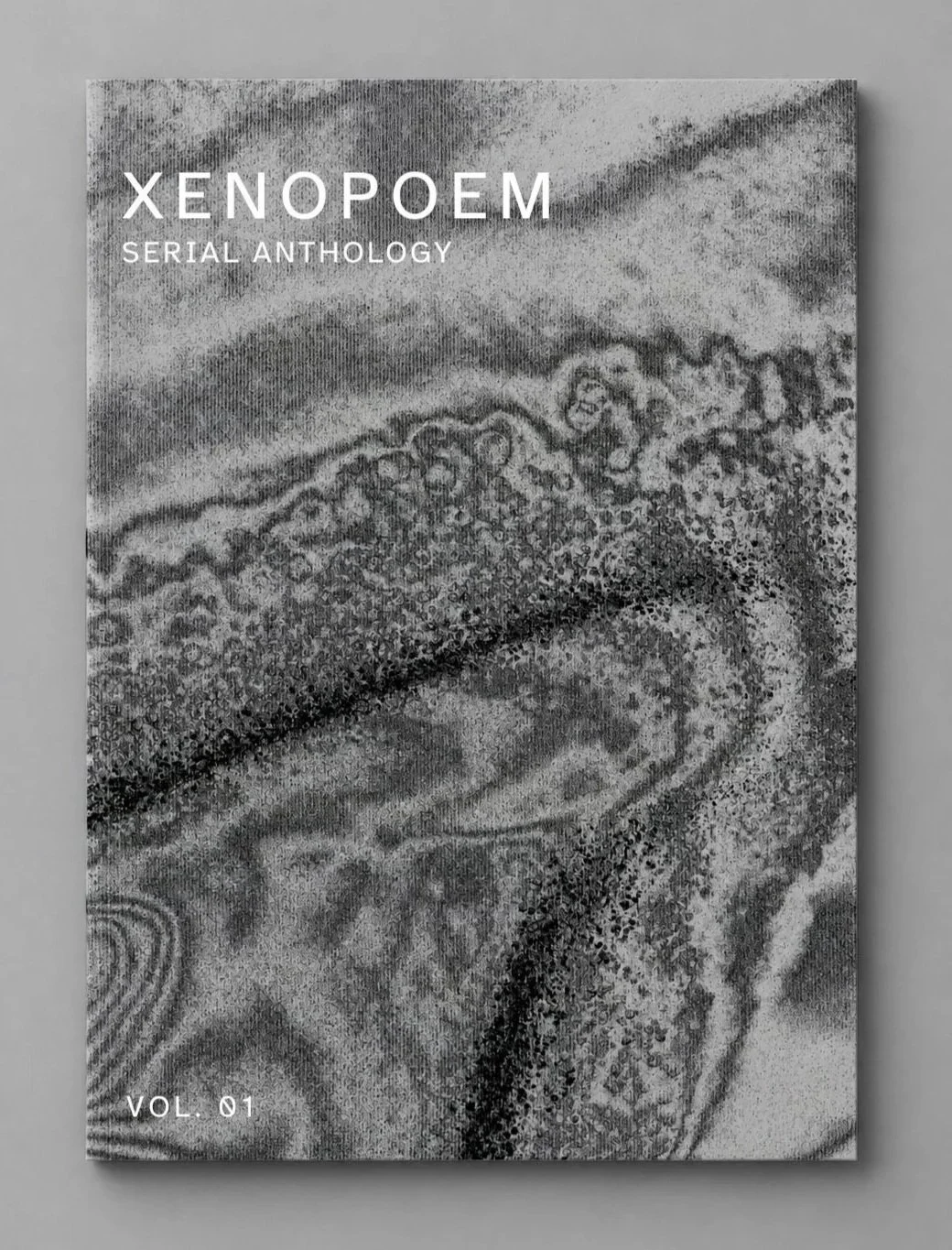
XENOPOEM / SERIAL ANTHOLOGY
VOL. 01・CALL FOR SUBMISSIONS
XENOPOEM / SERIAL ANTHOLOGY is an ongoing publication founded and edited by Zoetica Ebb and Kenji Siratori, emerging from Xenopoem Conference and the expanding network of practices and dialogues surrounding xenopoetics.
The anthology is conceived as a receiving system: a structure through which works, signals, responses, and records can enter into contact, undergo transmission, and continue in altered states.
In xenopoetics, “poem” does not designate a literary genre. It names a concentrated unit of form. The “xeno” marks an orientation toward what has not yet been assimilated or known.
A xenopoem acts through contact, producing structural mutation within the observer. It may do so through structure, timing, relation, perceptual pressure, distributed signals, instability, interruption, material exposure, or other operational means. Its effects may register affectively, bodily, subconsciously, or only after delay. The receiver becomes part of the work’s continuation.
For VOL. 01, we invite contributions that produce, register, test, or extend xenopoetic conditions.
We are particularly interested in what happens when a work enters another receiving system. What does it generate, resist, lose, acquire, or become?
RESEARCH
XENOPOEM / SERIAL ANTHOLOGY is also a research platform. We welcome experiments, observations, methods, and outcomes that test what a xenopoem can be, do, and become.
Research here is not limited to academic practice. A contribution may emerge from an ongoing investigation as well as a finished work.
The terms of xenopoetics are not fixed. Each volume will test, revise, and expand them through the independent investigations it brings into contact.
SCOPE OF WORK
We seek work that suspends familiar coordinates.
Submissions structured around identity positions, sexuality, gender discourse, political advocacy, or social issue commentary will not be considered. XENOPOEM / SERIAL ANTHOLOGY is tuned to another register.
We are interested in what happens when discourse, the self, and the known are no longer the primary engine.
The anthology is concerned with what a work does, and with how form, relation, process, signal, and encounter participate in reception.
INTERLOCUTION
Interlocution is a distinct editorial structure within XENOPOEM / SERIAL ANTHOLOGY.
A work may pass into another discipline or sensibility and be extended, challenged, or recomposed through response. Interlocution is not commentary added around a finished work. It alters the work and becomes part of its continuation.
Some selected works may be extended through interlocution within VOL. 01. Where this occurs, contributors will be contacted separately.
Interlocution is not an open submission category.
FORMS
Contributions may include experimental writing; images and image-text systems; dialogues; responses and transmissions; practice-led research formats; visual sequences; scores and diagrams; archives and residues; or other hybrid forms.
Work originating in performance, sound, moving image, installation, computational practice, or other non-print media is welcome. When such work enters the anthology, the conditions of print should be considered part of its new reception. Documentation, image sequences, scores, or other forms may become part of that translation.
We are not looking for conventional academic essays, artist statements, portfolio selections, or explanatory documentation presented in place of a contribution. The contribution itself should operate.
XENOPOEM CONFERENCE 2026
Material generated through contact with Xenopoem Conference 2026 remains welcome, including responses to works or interlocutions, altered works, observational reports, and accounts of technical or perceptual failure.
A work first presented during the conference may return only when the contribution responds to what happened there or what followed from that encounter. An unchanged reproduction does not fulfil this condition.
Submissions need not arise from the conference, and conference attendance is not required.
STATEMENT OF INTENT
Every submission must include a 250–500 word statement of intent.
This is not an artist statement and should not explain what the work means. It should demonstrate the conceptual and methodological rigour of the submission.
We are interested in evidence of sustained thought, experimentation, and deliberate formal decisions. Give us enough concrete information to assess the work without reducing it to an explanation of itself.
Describe your own process in your own terms. Do not restate or paraphrase these guidelines.
GENERATIVE AI
Except where generative AI is itself an integral operational component of the work, submissions generated, written, rewritten, or substantially developed using generative AI will not be considered.
Do not use AI to generate, rewrite, or tailor the statement of intent or other application text to these guidelines. Statements of intent must reflect the contributor’s own thinking and process.
Where generative AI forms an operational component of the work, its role must be clearly disclosed. Using AI to simulate conceptual rigour or reproduce the language and criteria of this call is grounds for rejection.
SPECIFICATIONS
Maximum text length: 10,000 words, excluding the statement of intent.
Shorter works and non-textual forms are equally welcome.
Deadline: March 1, 2027
No fees. Submission form below.
RECEIVE. DECIPHER. TRANSFORM.